Effect of Viral Infection on Host Wall Model Manufacturer,Supplier and Exporter in India
Product Code : JC-BE-6217
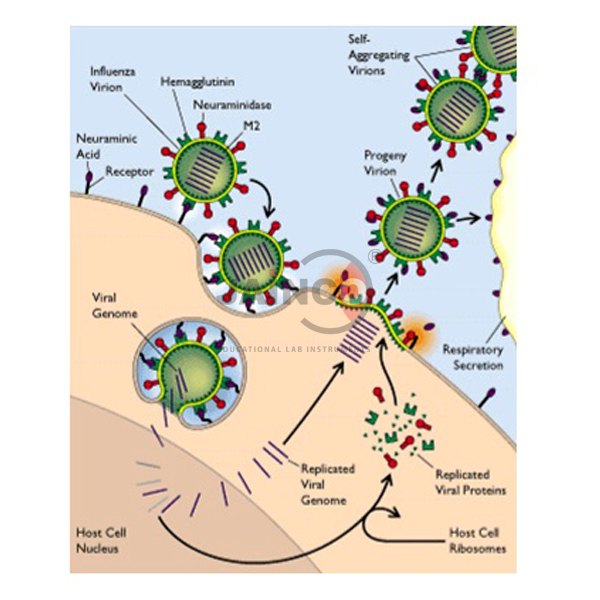
The Effect of Viral Infection on Host Wall Model from Jaincolab is an educational chart illustrating how viral infection ultimately damages and ruptures the structural wall of a host cell, most clearly demonstrated in bacteriophage infection of bacteria. During the lytic cycle, phage-encoded proteins called holins form pores in the host cell membrane, allowing phage-encoded endolysins (lysozyme-like enzymes) to reach and degrade the peptidoglycan layer of the bacterial cell wall, weakening it until internal osmotic pressure causes the cell to rupture and release new virions.
As a trusted biology lab equipment supplier in India, Jaincolab designs this model to give students a mechanism-level understanding of how a virus brings about host cell destruction, connecting molecular events (holin-endolysin action) to the visible outcome of lysis, supporting microbiology and virology teaching at school, college and university level.
What the Concept States
| Parameter | Details |
|---|---|
| Host System Illustrated | Bacterial cell wall (peptidoglycan layer) infected by a lytic bacteriophage |
| Trigger Event | Completion of the phage biosynthesis and assembly stages, timed by an internal molecular 'clock' encoded in phage genes |
| Key Protein 1: Holin | Accumulates in the host cell membrane and forms pores at a genetically timed point, disrupting membrane integrity |
| Key Protein 2: Endolysin | Released through holin pores; enzymatically degrades peptidoglycan bonds in the bacterial cell wall |
| Resulting Effect on Host Wall | Progressive weakening of the peptidoglycan layer, loss of structural rigidity, and eventual osmotic rupture of the cell (lysis) |
| Outcome for the Virus | Release of mature progeny virions from the destroyed host cell into the surrounding environment |
| Broader Relevance | Illustrates the general principle that cytolytic viruses damage host structural components as part of their release strategy |
Key Features
- Clearly labelled illustration of the holin-endolysin mechanism responsible for host cell wall breakdown
- Connects molecular-level events to the visible outcome of host cell lysis
- Reinforces understanding of the lytic cycle's final stage in greater mechanistic detail
- Durable, classroom- and laboratory-ready construction suitable for repeated use in practical sessions
- Supports microbiology, virology and molecular biology curricula
- Complements general viral replication cycle teaching models for a complete virology teaching set
Why Choose Jaincolab
Jaincolab is a well-established biology lab equipment supplier in India, serving schools, colleges and research institutions across India and internationally with ISO 9001:2015 and ISO 14001:2015 certified manufacturing. The Effect of Viral Infection on Host Wall Model is designed to accompany the Replication Cycle of Viruses Model and the Replication of DNA Viruses Model, giving institutions a coherent progression from viral genome replication through to the final destructive effect on the host cell. Every model is checked for labelling accuracy before dispatch, helping instructors present virology concepts with confidence.
Applications
| Application Area | Use |
|---|---|
| Schools & Colleges | Teaching the lytic cycle's cell-lysis mechanism as part of microbiology curricula |
| Microbiology & Virology Laboratories | Reference chart alongside bacteriophage culture and plaque assay practicals |
| Molecular Biology Courses | Illustrating gene-timed protein action (holin-endolysin system) in a real biological context |
| Medical & Paramedical Institutions | Foundation for understanding phage therapy and antibacterial mechanisms |
| Research and Teaching Laboratories | Visual reference for host-pathogen interaction discussions |
Frequently Asked Questions
Q1. What does the Effect of Viral Infection on Host Wall Model illustrate?
A. It illustrates how bacteriophage infection damages and ruptures the bacterial host cell wall, through the coordinated action of phage-encoded holin and endolysin proteins during the final stage of the lytic cycle.
Q2. What is the difference between holin and endolysin?
A. Holin is a phage protein that forms pores in the host cell membrane at a genetically timed point, while endolysin is an enzyme released through those pores that degrades the peptidoglycan of the bacterial cell wall, together causing cell lysis.
Q3. How does this model relate to the Replication Cycle of Viruses Model?
A. This model provides a detailed, mechanism-level view of the final 'release' stage shown in the broader Replication Cycle of Viruses Model, focusing specifically on how the host cell wall is destroyed.
Q4. Is this model suitable for undergraduate and postgraduate teaching?
A. Yes, the model supports microbiology, virology and molecular biology curricula from college introductory courses through postgraduate revision and laboratory demonstration.
Q5. Can Jaincolab supply this along with other virology and microbiology teaching models?
A. Yes, Jaincolab supplies this model alongside a full range of virology, microbiology and molecular biology teaching aids for biology laboratories across India and internationally.
Request a Quote
To request pricing or place an order for the Effect of Viral Infection on Host Wall Model, please contact our team with your requirement.