Recombinant DNA Technology Model Manufacturer,Supplier and Exporter in India
Product Code : JC-BE-6105
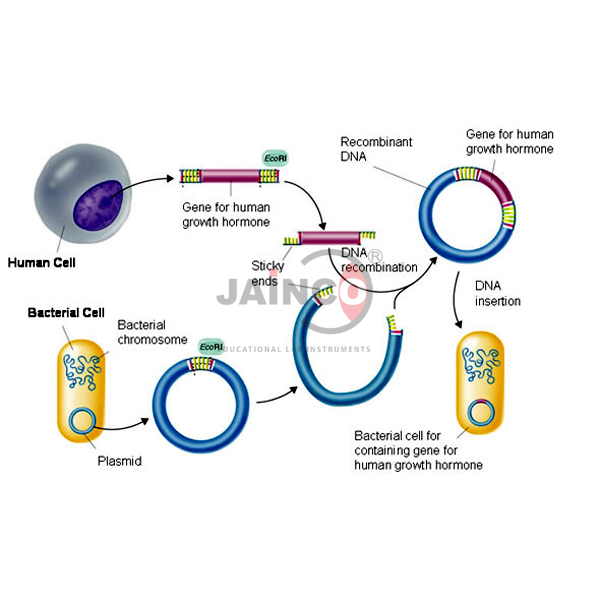
The Recombinant DNA Technology Model from Jaincolab is a three-dimensional teaching model that illustrates the steps used to combine DNA from different sources into a single recombinant molecule.
It is used in biotechnology, genetics, pharmacy, and medical courses to explain gene cloning using restriction enzymes, plasmid vectors, and host cell transformation.
What the Concept States
| Parameter | Details |
|---|---|
| Restriction Enzymes | Enzymes that cut DNA at specific recognition sequences, generating fragments for cloning |
| Plasmid Vector | A small circular DNA molecule used to carry a gene of interest into a host cell |
| Ligation | Joining a DNA fragment to a vector using DNA ligase to form recombinant DNA |
| Transformation | Introduction of recombinant DNA into a host cell, commonly bacteria |
| Selection Markers | Genes, such as antibiotic resistance genes, used to identify cells that have taken up the recombinant DNA |
| Applications | Recombinant DNA technology is used to produce proteins such as insulin and to create genetically modified organisms |
Key Features
- Illustrates the complete gene cloning process from restriction digestion to transformation
- Shows the role of plasmid vectors and selection markers
- Connects recombinant DNA technology to real-world biotechnology applications
- Durable, exam-oriented construction for repeated classroom use
- Compact benchtop format suitable for laboratories and lecture halls
Why Choose Jaincolab
Jaincolab (Jain Scientific Suppliers) is an ISO 9001:2015 and ISO 14001:2015 certified manufacturer and exporter of laboratory and scientific teaching models, supplying biology, chemistry, physics, and pharmacy equipment to institutions across India and internationally. Explore our complete range on the Biology Equipment category page, including our Gene Expression Model, for related molecular biology teaching aids.
Applications
| Application Area | Use |
|---|---|
| Biotechnology Education | Teaching the steps of gene cloning and recombinant DNA construction |
| Genetics Laboratories | Explaining the role of restriction enzymes and plasmid vectors |
| Pharmacy Colleges | Relating recombinant DNA technology to biopharmaceutical production |
| Medical Colleges | Correlating recombinant DNA methods with diagnostic and therapeutic applications |
| Science Exhibitions | Visual overview of gene cloning for general audiences |
Frequently Asked Questions
Q1. What does the Recombinant DNA Technology Model demonstrate?
A. It demonstrates how DNA from different sources is combined using restriction enzymes, plasmid vectors, and ligation to form recombinant DNA.
Q2. What is a plasmid vector?
A. A plasmid vector is a small circular DNA molecule used to carry a gene of interest into a host cell for cloning.
Q3. What is the role of restriction enzymes?
A. Restriction enzymes cut DNA at specific recognition sequences, producing fragments that can be inserted into a vector.
Q4. What is transformation?
A. Transformation is the process of introducing recombinant DNA into a host cell, commonly a bacterium.
Q5. Who uses this model?
A. Biotechnology, genetics, pharmacy, and medical students and faculty use it to study recombinant DNA technology.
Request a Quote
To request pricing or place an order for the Recombinant DNA Technology Model, please contact our team with your requirement.