Immunoglobulin Structure and Functions Model Manufacturer,Supplier and Exporter in India
Product Code : JC-BE-6130
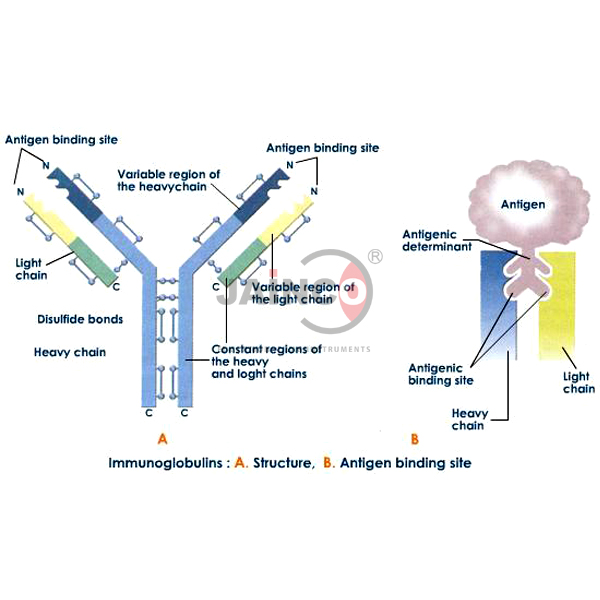
The Immunoglobulin Structure and Functions Model from Jaincolab is a three-dimensional teaching model that illustrates the basic structure of an antibody molecule and the distinct functions of each immunoglobulin class.
It is used in immunology and medical courses to explain the heavy and light chain arrangement, the antigen-binding and effector regions, and how IgG, IgM, IgA, IgD, and IgE differ functionally.
What the Concept States
| Parameter | Details |
|---|---|
| Basic Unit | Two heavy chains and two light chains joined by disulfide bonds |
| Variable Region (Fab) | Contains the antigen-binding site, unique to each antibody |
| Constant Region (Fc) | Mediates effector functions and binds to immune cell receptors |
| Immunoglobulin Classes | IgG, IgM, IgA, IgD, and IgE, distinguished by heavy chain type |
| IgG | Most abundant class in serum; crosses the placenta and provides long-term immunity |
| IgM | First antibody produced in a primary immune response; forms a pentameric structure |
Key Features
- Shows the heavy and light chain structure of an antibody molecule
- Distinguishes the variable (Fab) and constant (Fc) regions
- Compares the structure and function of all five immunoglobulin classes
- Durable, exam-oriented construction for repeated classroom use
- Compact benchtop format suitable for laboratories and lecture halls
Why Choose Jaincolab
As a trusted biology lab equipment supplier in India, Jaincolab (Jain Scientific Suppliers) is an ISO 9001:2015 and ISO 14001:2015 certified manufacturer and exporter of laboratory and scientific teaching models, supplying biology, chemistry, physics, and pharmacy equipment to institutions across India and internationally. Explore our complete range on the Biology Equipment category page, including our Cell Mediated Immune Response Model, for related immunology teaching aids.
Applications
| Application Area | Use |
|---|---|
| Immunology Education | Teaching antibody structure and immunoglobulin class function |
| Medical Colleges | Correlating immunoglobulin classes with clinical serology testing |
| Biotechnology Training | Supporting coursework on antibody engineering and diagnostics |
| Pathology Laboratories | Explaining immunoglobulin deficiencies and class-switching disorders |
| Science Exhibitions | Visual overview of antibody structure for general audiences |
Frequently Asked Questions
Q1. What does the Immunoglobulin Structure and Functions Model demonstrate?
A. It demonstrates the heavy and light chain structure of antibodies and the distinct functions of the five immunoglobulin classes.
Q2. What are the Fab and Fc regions of an antibody?
A. The Fab region contains the antigen-binding site, while the Fc region mediates effector functions and binds immune cell receptors.
Q3. Which immunoglobulin class is most abundant in serum?
A. IgG is the most abundant immunoglobulin class in serum and provides long-term immunity.
Q4. Why is IgM significant in a primary immune response?
A. IgM is the first antibody produced in a primary immune response and forms a pentameric structure.
Q5. Who uses this model?
A. Immunology, medical, and biotechnology students and faculty use it to study antibody structure and function.
Q6. Is this the same as the Antibody Structure Model?
A. No. The Immunoglobulin Structure and Functions Model covers the five immunoglobulin classes (IgG, IgM, IgA, IgD, and IgE) and their distinct biological functions, while the separate Antibody Structure Model focuses on the domain-level architecture of a single antibody molecule (variable and constant regions, disulfide bonds). Please specify the exact product title when ordering to avoid confusion between the two models.
Request a Quote
To request pricing or place an order for the Immunoglobulin Structure and Functions Model, please contact our team with your requirement.