Purine and Pyrimidine Metabolism Model Manufacturer,Supplier and Exporter in India
Product Code : JC-BE-6104
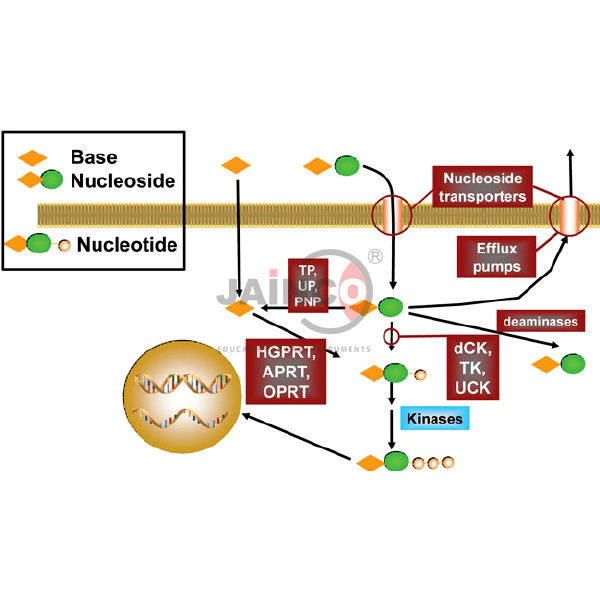
The Purine and Pyrimidine Metabolism Model from Jaincolab is a three-dimensional teaching model that illustrates how purine and pyrimidine bases are synthesized, recycled, and broken down in the body.
It is used in biochemistry, genetics, and medical courses to connect nucleotide metabolism with clinical conditions such as gout and inherited metabolic disorders.
What the Concept States
| Parameter | Details |
|---|---|
| Purine Bases | Adenine and guanine, synthesized de novo from amino acid precursors or recycled through salvage pathways |
| Pyrimidine Bases | Cytosine, thymine, and uracil, synthesized from carbamoyl phosphate and aspartate |
| De Novo Synthesis | Building purine and pyrimidine bases from simple precursor molecules |
| Salvage Pathway | Recycling of free bases and nucleosides from nucleic acid turnover to reform nucleotides |
| Purine Degradation | Purines are broken down to uric acid, which is excreted in urine |
| Clinical Relevance | Disorders of purine metabolism include gout and Lesch-Nyhan syndrome |
Key Features
- Illustrates both de novo synthesis and salvage pathways for purines and pyrimidines
- Shows the degradation pathway of purines to uric acid
- Links nucleotide metabolism to clinical conditions such as gout
- Durable, exam-oriented construction for repeated classroom use
- Compact benchtop format suitable for laboratories and lecture halls
Why Choose Jaincolab
Jaincolab (Jain Scientific Suppliers) is an ISO 9001:2015 and ISO 14001:2015 certified manufacturer and exporter of laboratory and scientific teaching models, supplying biology, chemistry, physics, and pharmacy equipment to institutions across India and internationally. Explore our complete range on the Biology Equipment category page, including our DNA Repair Mechanism Model, for related biochemistry teaching aids.
Applications
| Application Area | Use |
|---|---|
| Biochemistry Education | Teaching purine and pyrimidine synthesis and degradation pathways |
| Medical Colleges | Correlating nucleotide metabolism with gout and metabolic disorders |
| Genetics Laboratories | Explaining the link between nucleotide metabolism and nucleic acid synthesis |
| Pharmacy Colleges | Relating nucleotide metabolism to drugs used in gout and cancer treatment |
| Science Exhibitions | Visual overview of nucleotide metabolism for general audiences |
Frequently Asked Questions
Q1. What does the Purine and Pyrimidine Metabolism Model demonstrate?
A. It demonstrates how purine and pyrimidine bases are synthesized through de novo and salvage pathways and how purines are ultimately broken down to uric acid.
Q2. What is the difference between de novo synthesis and the salvage pathway?
A. De novo synthesis builds new bases from simple precursor molecules, while the salvage pathway recycles free bases and nucleosides from nucleic acid turnover.
Q3. What condition is associated with purine metabolism disorders?
A. Disorders of purine metabolism are associated with conditions such as gout and Lesch-Nyhan syndrome.
Q4. What are pyrimidine bases synthesized from?
A. Pyrimidine bases are synthesized from carbamoyl phosphate and aspartate.
Q5. Who uses this model?
A. Biochemistry, genetics, medical, and pharmacy students and faculty use it to study nucleotide metabolism.
Request a Quote
To request pricing or place an order for the Purine and Pyrimidine Metabolism Model, please contact our team with your requirement.