
Science Kit
Scientific Instrument
- Power Supplies and Transformers
- Training Kits for Communication Lab
- Digital Electronic Experiments Computer Principles
- Study of Multivibrators
- Characteristics Operational Amplifiers
- Verification of Network Theorem
- Amplifiers Kits
- Demonstration Models
- Verification of Various Laws and Conservation of Signal
- Semi Conductor Devices
- Laser Experiment
- Characteristics Of Vaccum Tubes
- E M Apparatus Instrument
- Microprocessors
- OPTO Electronic Devices Equipments
- Digital Measuring Instruments
- Nuclear Physics
- Test and Measuring Instruments
Educational Rock and Minerals
Biology Equipment
- Prepared Slides Equipments
- Plant Equipment
- Magnifier Equipment
- Animal Equipments
- Biotechnology Equipments
- Cell Equipments
- Classification Equipments
- Dissection Equipments
- Electrophoresis Equipments
- Enzyme Equipments
- Genetics and Inheritance Equipments
- Health Equipments
- Human Biology Equipments
- Microbiology Equipment
- Molecular Model Equipment
Soil Testing
Rock Testing
Best Lab Equipment
Educational Lab Equipment
Analytical Lab Instrument
- Electrochemistry Instruments
- Flame Photometer
- Pharmacology Instruments
- Tablet Making Machine
- Apparatus For Isolated Uterus Intestine
- Water Still
- B.O.D. Incubator
- Egg Incubator
- Incubator Bacteriological
- Drying Oven Industrial
- Hot Air Universal Oven
- Shaker
- Incubators
- Hot Plate
- Clean Air Equipments
- Baths
- Autoclaves
- Surveying Instruments
- Pipette Washer (Automatic)
- Tissue Homogeniser
- Moisture Meter
- Mortuary Chamber
- Soxhlet Extraction Unit
- Kjeldahl Units (Without Glass Part)
- pH Meters
- Conductivity Meter
- Salinity Meter
- Dissolved Oxygen Meters
- Turbidity Meters
- Colony Counter
- Moisture Titrator
- Fluorometer
- Dissolution Test Apparatus
- Friability Test Apparatus
- Pyrogen Testing Instrument
- Tap or Bulk Density Apparatus
- Leak Test Apparatus
- Flocculator Jar Test Apparatus
- Microprocessor Flame Photometers
- Pharmacy Laboratory Equipments
- Respiration Pumps
- Brodie Operating Tables
- Embalming Tables
- Rat Operating Tables
- Small Animal Operating Tables
- Animals Holders
- Animals Head Holders
- Pneumograph Stethographs
- Spirometers
- Benedict Roth Recording Spirometers
- Digital Respinometers
- Organ Baths
- Isolated Organ Baths Digitals
- Four Unit Organ Baths
- Perfusions Lagendroff Assembly
- Dubois Raymond Keys
- Simple Keys
- Induction Coils
- Student Induction Coils
- Variable Interrupters
- Mosses Ergographs
- Compass Aesthesiometers
- Hand Grip Dynamometers
- Skin Fold Calipers
- Macerators
- Tablet Polishing Pans
- Tablet Making Machines (Electrically Operated)
- Tablets Making Machine Motorised
- Tablets Making Machine Hand Operated
- Apparatus Isolated Uterus Intestine
- Clean Air Benches
- Bio Safety Cabinet
- Laboratory Fume Hoods
- Fumigation
- Environmental Growth Chamber
- Ovens
- Water Distillation Plant
- Water Baths
- Hot Plates Warming Tables
- Dry Block Digester
- Shaking Machines And Stirrers
- COD Digester
- General Laboratory Equipment
- Spectrophotometer
- pharmaceutical-instruments/Pharmacology Equipments
Laboratory Apparatus
Laboratory Equipments Supplies
Engineering Lab Equipment
- Metallurgical Equipment
- Survey Instruments
- Incinerator
- Razor Sharpener
- Heat Transfer Lab Equipment
- Fluid Mechanics Lab Equipment
- Civil Engineering Lab Equipment
- Charts
- Bottle Top Dispenser
- Adsorption in Packed Beds
- Botany Charts
- Zoology Chart
- Chemistry Charts
- Physics Charts
- General Science Charts
- Genetics and Evolution Charts
- Human Physiology Charts
- Life Sketch of Scientists
- Food And Nutrition
- Health Care Series
- Prevent Diseases
- First Aid Charts
- Yogasana Charts
- Mathematics Primary Charts
- Charts on Geography
- Changing Face of the Earth
- Man and Environment
- Weather Maps of India
- Alphabet Charts
- Special Charts
- Moral Story Charts
- Specials Roll ups
- Struggle For Indian Freedom
- National Integration Charts
- Life Sketch of Great Men
- English Teaching Charts
- English Grammar Charts
- Military Science
- Army, Police and NCC Charts
- Maps Charts
- State Maps Political
- Civil and Draughtsman Equipment
- Nautical Compass
- Survey Equipment
- Soil Testing Equipments
- Measuring Instruments
- Tripods Stands
- Portholes
- Nautical Sextants
- Prism Sets
- CNC Trainer Machine
- Training Workshop Labs
- Mechanical Engineering Lab Equipment
- Air Conditioning and Refrigeration
- Automotive and Transportation
- Building Material Testing
Maths Lab Equipment
Porcelain Ware
Hospital Lab Equipments
Anatomical Models
- Dental Models
- Skeletons For Medical Students
- ENT Models
- Cancer Model
- Diabetes Model
- Implant Models
- Brain Models, Neuro Models
- Liver and Gastro Models
- Gynae Models, Female Health, Utreus Models
- Four Stage Liver Models
- Special Models
- Arthritis Models
- Heart and Artery Models
- Ortho Models
- Heart and Lungs Models
- Nurse Training Models
- Life Support Training Models
- Human Models
- Anatomical Models Equipments
Vocational Training Laboratory Equipment
- Woodworking Workshop Machines
- Wood Workshop Portable Tool
- Plant Engineering and Welding Equipment
- Welding Equipment and Workshop Lab Machine
- Standard Welding Equipment Set
- Electrical Work Bench
- Workshop Tools
- Plumbing Workshop Instrument
- Concrete Laboratory
- Soil Mechanics
- Hydraulics and Pneumatics
- Metal Manufacturing Training Machine
- Washing Machines
- Textile Technology
Lab Glassware
- Watch Glass Soda
- Voltameters
- Stirrers
- Test Tubes and Thermometer Pockets
- Staining Jars Glassware
- Specimen Tubes and Vials
- Spirit Burners
- Screwthreads, Discs and Joints
- Screw Caps, Stoppers and Stopcocks
- Distillation
- Extractors
- Coplins Jars
- Condenser
- Chromatography Columns
- Bends
- Beakers and Flasks
- Laboratory Adapter Oscilloscope Kit
Electronics Lab Equipments
- Variac Dimmerstats
- Signal Generators
- Fiber Optic Trainers
- Digital Storage Oscilloscopes
- Digital Electronics Trainer
- Communication Trainer
- Breadboard Trainers
- Analog Electronics Trainer
- Oscilloscopes
- Power Electronics Trainers
- Electronic Fundamentals
- Audio and Visual Technology
- Radio and Telephone Communications
- Electrical Technology
- Wiring, Distribution and Protection
- Electrical Motor Control
- Data Acquisition, Instrumentation and Process Control
- Lighting and Building Control Systems
- Automotive Electrical Trainers and Components
Lab Plasticware
Chemistry Lab Equipment
Physics Lab Equipment
- Measurement
- Magnetisms
- Heat
- AP Physics
- Physics Lab Equipments
- Atomic Physics Equipment
- Density Equipment
- Electricity Equipment
- Electromagnetism Equipment
- Electrostatics Equipment
- Energy Transfer Equipment
- Force Motion And Dynamic Equipment
- Mechanics Lab Equipment
- Light And Optics Equipment
- Renewable Energy Equipment
- Sound and Waves
- Education Kit
Geography Lab Models
Fiber Optic Trainers Manufacturer, Suppliers and Exporter in India
Jaincolab Manufacturers is a leading Fiber Optic Trainers Manufacturer, Supplier, and Exporter in India, United States, Indonesia, Brazil, Bangladesh, Mexico, Japan, Egypt, Philippines, Democratic Republic of the Congo, Vietnam, Iran, Turkey, Tanzania, United Kingdom, France, South Africa, Italy, Kenya, Colombia, Sudan, Uganda, South Korea, Argentina, Afghanistan, Yemen, Angola, Morocco, Poland, Uzbekistan, Mozambique, Malaysia, Ghana, Saudi Arabia, Peru, Madagascar, Côte d’Ivoire, Cameroon, Niger, Venezuela, Australia, Syria, Mali, Burkina Faso, Sri Lanka, Malawi, Zambia, Chad, Kazakhstan, Somalia, Chile, Senegal, Ecuador, Cambodia, Zimbabwe, Guinea, Benin, Rwanda, Burundi, Bolivia, South Sudan, Tunisia, Haiti, Belgium, Dominican Republic, Jordan, United Arab Emirates, Honduras, Tajikistan, Papua New Guinea, Portugal, Togo, Sierra Leone, Belarus, Laos, Turkmenistan, Libya, Kyrgyzstan, Nicaragua, Paraguay, Bulgaria, Serbia, Republic of the Congo, Lebanon, Liberia, Central African Republic, Palestine, Oman, Mauritania, New Zealand, Costa Rica, Kuwait, Panama, Croatia, Georgia, Eritrea, Mongolia, Uruguay, Qatar, Namibia, Bosnia and Herzegovina, Moldova, Armenia, Gambia, Jamaica, Lithuania, Albania, Gabon, Botswana, Lesotho, Guinea-Bissau, Slovenia, Equatorial Guinea, Latvia, North Macedonia, Bahrain, Trinidad and Tobago, Timor-Leste, Cyprus, Estonia, Eswatini, Mauritius, Djibouti, Fiji, Comoros, Solomon Islands, Guyana, Bhutan, Luxembourg, Suriname, Montenegro, Malta, Maldives, Cabo Verde, Brunei, Belize, Bahamas, Iceland, Vanuatu, Barbados, São Tomé and Príncipe, Samoa, Saint Lucia, Kiribati, Seychelles, Grenada, Saint Vincent and the Grenadines, Antigua and Barbuda.
What does the fibre optic trainer range include?
This range has nine fibre optic trainers and one optical power meter for electronics, communication and physics labs. They cover digital, analogue and voice links over plastic fibre, and two link trainers with AM, FM and PWM. Others cover laser diode modulation, numerical aperture and the physics of light in a fibre. The power meter reads optical power at 850, 1310 and 1550 nm.
- Fibre-Optic Simplex Digital Transceiver Trainer (JA-FOT-1537)
- Advanced Fibre Optic Digital Transceiver Trainer (JA-FOT-1539)
- Elementary Fiber Optics Trainer (JA-AET-1477)
- Advanced Fiber Optics Trainer (JA-AET-1478)
- Advanced Fibre Optic Analogue Transceiver Trainer (JA-FOT-1538)
- Fibre Optic Voice Transmitter and Receiver Trainer (JA-FOT-1541)
- Laser Diode Intensity Modulation and Demodulation Trainer (JA-FOT-1542)
- Fibre Optic Trainer for Numerical Aperture (JA-FOT-1540)
- Physics of Fiber Optics Trainer (JA-FOT-1543)
- Fiber Optic Power Meter (JA-FOT-1544)
Trainer groups in the fibre optic range
| Group | Items | What it covers |
|---|---|---|
| Digital links | Fibre-Optic Simplex Digital Transceiver Trainer (JA-FOT-1537), Advanced Fibre Optic Digital Transceiver Trainer (JA-FOT-1539) | A 660 nm digital transmitter and receiver; the advanced model adds an encoder and a decoder |
| Analog and digital link trainers with AM, FM and PWM | Elementary Fiber Optics Trainer (JA-AET-1477), Advanced Fiber Optics Trainer (JA-AET-1478) | A 660 nm simplex link, and a full duplex link at 660 and 950 nm with RS232 PC-to-PC communication; both have a function generator, a voice link, switched faults, an NA jig and a mandrel |
| Analogue and voice links | Advanced Fibre Optic Analogue Transceiver Trainer (JA-FOT-1538), Fibre Optic Voice Transmitter and Receiver Trainer (JA-FOT-1541) | A 650 nm analogue link with a silicon photodiode receiver, and a 660 nm voice link with a phototransistor receiver and speaker; both use 1 m and 5 m PMMA fibre |
| Laser and fibre physics | Laser Diode Intensity Modulation and Demodulation Trainer (JA-FOT-1542), Fibre Optic Trainer for Numerical Aperture (JA-FOT-1540), Physics of Fiber Optics Trainer (JA-FOT-1543) | Laser diode modulation with plastic and glass fibre; numerical aperture by the far-field spot method; fibre physics with an NA jig and a mandrel |
| Measuring instrument | Fiber Optic Power Meter (JA-FOT-1544) | Optical power readings at 850, 1310 and 1550 nm |
Link and transceiver trainers compared
Each trainer is listed with the values its product page gives. "Not listed" means the page does not state the value.
| Product | Product code | Link type | Source | Receiver | Fibre supplied | Power |
|---|---|---|---|---|---|---|
| Fibre-Optic Simplex Digital Transceiver Trainer | JA-FOT-1537 | Digital simplex link with a timer square-wave source | 660 nm digital transmitter | Digital receiver | Not listed | 230 V, 50 Hz |
| Advanced Fibre Optic Digital Transceiver Trainer | JA-FOT-1539 | Digital link with encoder and decoder | 660 nm digital transmitter | Digital receiver | Not listed | 230 V, 50 Hz |
| Elementary Fiber Optics Trainer | JA-AET-1477 | Simplex analog and digital link; AM, FM and PWM; voice link | 660 nm LED | Photodetector | 0.5 m and 1 m PMMA with SMA connectors | 230 V AC, 50 Hz mains adapter; earlier units carry a 220 V nameplate |
| Advanced Fiber Optics Trainer | JA-AET-1478 | Full duplex analog and digital link; AM, FM and PWM; RS232 PC-to-PC communication | 660 nm and 950 nm LEDs | Two photodetectors | 1 m, 2 m and 5 m plastic optical fibre cables with matched connectors | Universal mains adapter, 100 to 240 V AC, 50/60 Hz, with a low-voltage DC output |
| Advanced Fibre Optic Analogue Transceiver Trainer | JA-FOT-1538 | Analogue link, DC or audio coupling as ordered; 20 Hz to 100 kHz at -3 dB on the 1 m link | 650 nm red LED | Silicon photodiode | 1 m and 5 m of 1 mm PMMA step-index fibre | 12 V DC adapter |
| Fibre Optic Voice Transmitter and Receiver Trainer | JA-FOT-1541 | Voice link, microphone to speaker | 660 nm transmitter with audio amplifier | Phototransistor with 8 ohm speaker | 1 m and 5 m PMMA patch cords | 230 V, 50 Hz |
| Laser Diode Intensity Modulation and Demodulation Trainer | JA-FOT-1542 | Laser diode intensity modulation, ACC or APC | Laser diode module | PIN diode | 2 m step-index plastic and 2 m graded-index glass | 230 V, 50 Hz |
Fibre physics trainers and the power meter
| Product | Product code | Source | Detector | Fibre or connectors | Measurement aids |
|---|---|---|---|---|---|
| Fibre Optic Trainer for Numerical Aperture | JA-FOT-1540 | Low-power red LED, nominally 650 nm | None; the spot is read on a ruled screen | 1 m of 1 mm PMMA step-index fibre; NA about 0.5 | Launch and coupling block; ruled screen; stand with distance scale |
| Physics of Fiber Optics Trainer | JA-FOT-1543 | LED, 635 nm (red, visible) | Two silicon photodetectors | 1000 micron step-index plastic fibre, 1 m and 5 m | NA jig and scale; 8-LED signal strength indicator; built-in function generator |
| Fiber Optic Power Meter | JA-FOT-1544 | None (meter) | Germanium photodiode | ST and FC connectors | 850, 1310 and 1550 nm; 1 mV per dB output |
How to choose a fibre optic trainer
- To show how data travels over fibre, choose a digital link trainer. The simplex model (JA-FOT-1537) uses a 660 nm transmitter and a timer square-wave source; the advanced model (JA-FOT-1539) adds an encoder and a decoder.
- For AM, FM and PWM, the Elementary Fiber Optics Trainer gives a simplex 660 nm link with a voice link and switched faults. The Advanced Fiber Optics Trainer adds a 950 nm channel, full duplex working and RS232 PC-to-PC communication.
- To measure an analogue link, choose the analogue transceiver (JA-FOT-1538). Its 650 nm LED and silicon photodiode give 20 Hz to 100 kHz at -3 dB on the 1 m fibre. A mandrel is supplied for bend-loss tests.
- For a first demonstration students can hear, the voice trainer (JA-FOT-1541) sends speech from a microphone to an 8 ohm speaker over the fibre.
- To work with a laser source and glass fibre, choose the laser diode trainer (JA-FOT-1542). It has ACC and APC modes, a PIN diode receiver and both plastic and glass patch cords.
- For numerical aperture alone, the NA trainer (JA-FOT-1540) uses the far-field spot method with a ruled screen and a distance scale. The Physics of Fiber Optics Trainer (JA-FOT-1543) adds an NA jig, two photodetectors and a built-in function generator.
Practicals covered by these trainers
Who uses these trainers
Electronics, communication and physics laboratories in engineering colleges, polytechnics and universities use these trainers for optical communication practicals. The simplex trainer page lists operating instructions, and the power meter comes with a carrying case, a battery and a user manual.
Ordering fibre optic trainers
Quote the product code of each trainer. Several pages list extra instruments for the practicals, such as a 20 MHz oscilloscope, an AF/RF generator or a fibre optic power meter. Add these to your enquiry if your lab does not have them.
The Elementary Fiber Optics Trainer uses a 230 V AC, 50 Hz mains adapter, and earlier units carry a 220 V nameplate. The Advanced Fiber Optics Trainer uses a universal 100 to 240 V AC, 50/60 Hz adapter. The analogue transceiver uses a 12 V DC adapter, and the other mains trainers list 230 V, 50 Hz. Send the list through our contact page.
Communication and electronics ranges related to fibre optics
Fibre optic trainers are grouped in the Electronics Lab Equipments range from JaincoLab, an electronics lab equipment manufacturer in India.
| Range | What it covers |
|---|---|
| Communication Trainer | AM, FM, pulse and digital modulation trainers, multiplexing, transmission line and LAN trainers |
| Radio and Telephone Communications | AM FM radio, CB transceiver, walkie talkie, mobile phone and microwave trainers |
| Oscilloscopes | 30 MHz and 20 MHz dual trace oscilloscopes, an oscilloscope with digital readout and a frequency counter |
| Digital Storage Oscilloscopes | Digital storage oscilloscopes, including dual channel and four channel models |
| Signal Generators | Function generators, an AM and FM function generator and an RF signal generator |
| Analog Electronics Trainer | Training boards for diodes, transistors, amplifiers, oscillators, filters and bridges |
| Digital Electronics Trainer | Logic training boards for gates, flip-flops, counters, converters, multiplexers and decoders |
| Breadboard Trainers | Digital and analog breadboard labs, logic trainers, a power project board and a power electronics lab |
| Power Electronics Trainers | SCR, triac and UJT trainers, thyristor converters, choppers, inverters and motor speed control |
| Electronic Fundamentals | Basic electricity and electronics trainers, base station systems, and op-amp, communications and biomedical trainers |
| Audio and Visual Technology | Television, audio, DVD, video camera, CCTV and intercom trainers |
| Data Acquisition, Instrumentation and Process Control | PLC trainers, a conveyor system, process panels and temperature and level control trainers |
| Electrical Technology | Electrical measurement, transformer and metering, and appliance repair trainers |
| Wiring, Distribution and Protection | Electrical installation, circuit fault and electrical machine trainers |
| Lighting and Building Control Systems | Security and fire alarm trainers and a DDC control training system |
Frequently Asked Questions
How is the numerical aperture of an optical fibre measured?
Pass light through the fibre onto a screen and measure the diameter of the bright spot and its distance from the fibre end. Half the cone angle is the acceptance angle, and the numerical aperture is the sine of that angle. Repeat at a second distance to check the reading.
Why does bending a fibre increase the loss?
At a tight bend, light meets the core boundary at too steep an angle to be reflected back. Part of it escapes into the cladding. The loss grows quickly as the bend gets tighter. Students can show this by winding the fibre round a mandrel while watching the received signal.
Is it safe for students to look into the end of a fibre?
No. Never look into a fibre end or a connector while the source is on. Laser diode sources can harm the eye even when the light looks dim, and infrared light cannot be seen at all. Switch the source off before inspecting a fibre and cap unused connectors.
How should fibre offcuts be handled in a student lab?
Glass fibre offcuts are thin splinters that can pierce skin and are hard to see. Collect them on tape or in a marked container, and never brush them off the bench by hand. Keep food and drink away from the work area.
What should the supply of a fibre optic trainer include before an institution orders it?
Ask for a contents list for each trainer: patch cords and their lengths, adaptors, jigs, cables and the manual. Several product pages list these, such as 1 m and 5 m patch cords and an NA jig. Check whether extra instruments are needed, and send the list through our contact page.
Will the patch cords and connectors match the fibre equipment we already have?
Name the connector type on your existing trainers and meters in the enquiry. The power meter page lists ST and FC connectors, and several trainers use an in-line SMA adaptor, so cords and adaptors can be matched. Send the details through our contact page.
For a quotation, list the trainers with their product codes and the number of sets you need, and send it through our contact page. For tender or project supply, see our tenders page.
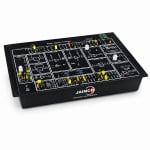
Elementary Fiber Optics Trainer
Product Code : JA-AET-1477
Simplex analogue and digital fibre optic link trainer at 660 nm with AM, FM and PWM, voice link, 4.096 MHz clock, NA jig, mandrel and PMMA fibre cables. 230 V AC, 50 Hz mains adapter with isolated low-voltage output.
View Details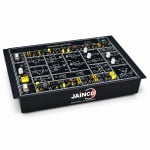
Advanced Fiber Optics Trainer
Product Code : JA-AET-1478
Full-duplex analogue and digital fibre optic link trainer with 660 nm and 950 nm channels: AM, FM and PWM, voice link, RS232 PC-to-PC link, NA jig, mandrel, plastic fibre set (1, 2 and 5 m), optical power measurement and universal mains adapter.
View Details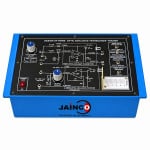
Fibre-Optic Simplex Digital Transceiver Trainer
Product Code : JA-FOT-1537
The Fibre-Optic Simplex Digital Transceiver Trainer is a bench board for studying a one-way digital fibre-optic link: designing the link, observing rise-time and fall-time distortion and measuring propagation delay.
View Details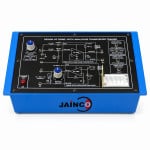
Advanced Fibre Optic Analogue Transceiver Trainer
Product Code : JA-FOT-1538
Analogue fibre optic link trainer: 650 nm red LED transmitter, silicon photodiode receiver, 1 mm PMMA step-index fibre in 1 m and 5 m lengths, DC or audio coupling, link bandwidth 20 Hz to 100 kHz (-3 dB, 1 m link), 12 V DC adapter.
View Details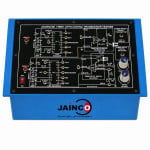
Advanced Fibre Optic Digital Transceiver Trainer
Product Code : JA-FOT-1539
The Advanced Fibre Optic Digital Transceiver Trainer extends a 660 nm digital fibre link with an encoder and decoder, so students can compare line codes as well as measure link behaviour.
View Details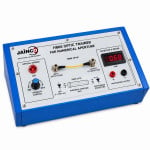
Fibre Optic Trainer for Numerical Aperture
Product Code : JA-FOT-1540
Fibre optic trainer for numerical aperture: low-power 650 nm red LED, 1 m of 1 mm PMMA step-index fibre (NA about 0.5), launch and coupling block, ruled screen and stand with distance scale. NA = sin(arctan(D/2L)) from spot readings.
View Details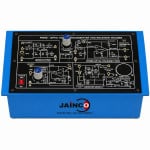
Fibre Optic Voice Transmitter and Receiver Trainer
Product Code : JA-FOT-1541
The Fibre Optic Voice Transmitter and Receiver Trainer sends audio and speech over plastic optical fibre: a microphone feeds an audio amplifier and a 660 nm fibre-optic transmitter, and a phototransistor detector drives an 8 ohm speaker at the far end.
View Details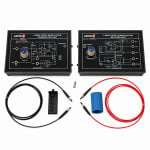
Laser Diode Intensity Modulation and Demodulation Trainer
Product Code : JA-FOT-1542
The Laser Diode Intensity Modulation and Demodulation Trainer is a two-unit set, a laser diode transmitter and a receiver, for characterising a laser diode and building analogue, digital and free-space optical links.
View Details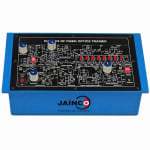
Physics of Fiber Optics Trainer
Product Code : JA-FOT-1543
The Physics of Fiber Optics Trainer introduces optical fibre behaviour with a 635 nm red LED transmitter, two silicon photodetectors and 1 m and 5 m plastic fibres, then builds analogue, digital and voice links.
View Details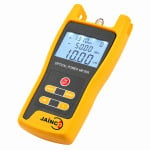
Fiber Optic Power Meter
Product Code : JA-FOT-1544
The fiber optic power meter measures optical power in fibre-optic lab work at 850 nm, 1310 nm and 1550 nm, using a germanium photodiode.
View Details