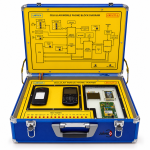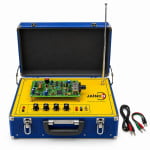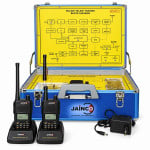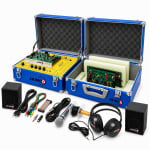
Radio Communication Training System Manufacturer,Supplier and Exporter in India
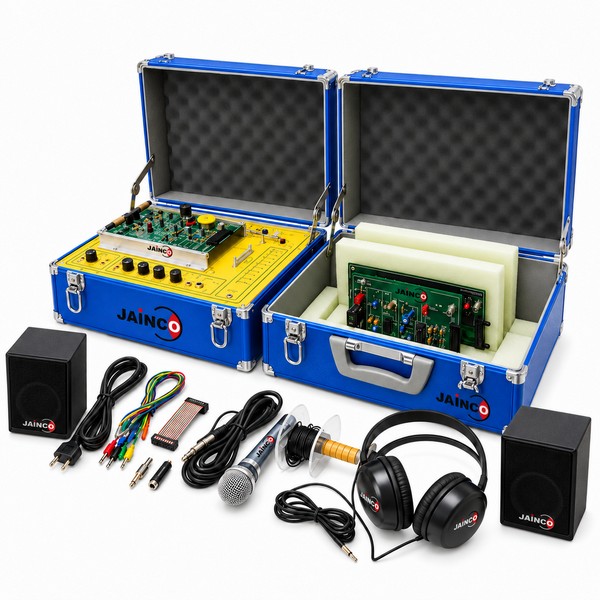
Product Code : JA-RATC-9592
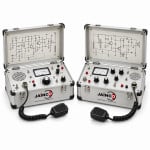
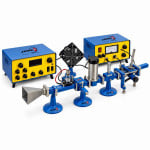
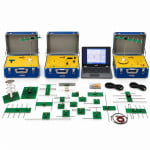
The Radio Communication Training System is a modular radio course on two stations, one transmitting and one receiving. A selectable carrier of about 100 kHz to 1 MHz travels over shielded 50 ohm cable at 0 dBm or less, so nothing radiates. Students build AM and FM links from source, mixer, filter, modulator and receiver modules.
Specifications of the radio communication training system
| Product code | JA-RATC-9592 |
|---|---|
| Stations | Two modular stations: one transmit channel and one receive channel |
| Carrier | Selectable conducted carrier in the classroom band of about 100 kHz to 1 MHz |
| Output level | 0 dBm or less into 50 ohm, as a design limit |
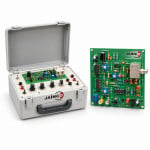
| Modules | Source, mixer and filter, modulator and demodulator, receiver and display, attenuators and terminators; each module covers one receiving or transmission technology |
| Modulation | AM and FM; separate ASK/FSK demonstration module as an order option |
| Connections | Shielded |
| Power supply | Isolated 12 V DC system supply |
| Construction | Special boards with the circuit components mounted for easy access |
| Courseware | Structured from basic RF principles to advanced concepts |
| Manufacturer | JaincoLab, Ambala, India |
Building radio links on the training system
- Building a link. Join the source, modulator, attenuator and receiver modules with shielded leads and terminate every open port. Follow the carrier and the message through each stage on the 30 MHz Oscilloscope.
- Mixer and filter. Combine the carrier with a second frequency in the mixer module, then use the filter to select the sum or the difference. Check which product you have with the Frequency Counter.
- Attenuation in dB. Insert attenuators one at a time between the stations and note how the received level falls. Find the level at which the receiver display stops giving a clean output.
- Digital keying. Fit the optional ASK/FSK module and record its waveforms. Compare them with the Amplitude Shift Keying Modulation and Demodulation and Frequency Shift Keying Modulation and Demodulation boards.
Frequently Asked Questions
What comes out of the mixer module, and why is a filter needed after it?
A mixer combines two signals and produces new frequencies at their sum and their difference, plus some of the original inputs. The filter after it passes the one product you want and blocks the rest. This is how a receiver moves every station to its intermediate frequency.
Why are signal levels on the training system given in dBm?
dBm compares a power with one milliwatt on a log scale, so gains and losses simply add and subtract. An attenuator marked in dB is subtracted from the source level, and an amplifier's gain is added. That makes a link budget quick to work out on paper and easy to check on the bench.
In what order should the modules be taught?
Start with the source and the attenuators, so students learn levels and terminations first. Then add the modulator and receiver for an AM link, move on to FM, and finish with the mixer and filter. The optional ASK/FSK module fits at the end as a bridge to digital communication.
Which test instruments are needed alongside the system?
An oscilloscope covers most of the work, because the carrier stays at about 1 MHz or below. A frequency counter helps with the mixer experiments, and a multimeter checks the 12 V DC supply. A spectrum analyser is not essential, although it makes the mixer products easier to see.
Does the training system need radio approval before import?
The base system is conducted: the carrier runs on shielded cable at 0 dBm or less into 50 ohm, with no antenna. A version that radiates is a radio transmitter, and radio transmitters usually need an import licence or type approval in the buyer's country. Check with your telecom regulator before ordering any radiating variant.
What should our tender list in the scope of supply for this system?
List the two stations, the modules you need, the attenuators, terminators and shielded leads, the 12 V DC supply and the courseware. State whether the ASK/FSK module is wanted. JaincoLab service engineers can install the system, and a team can demonstrate it to your staff.
Other trainers in the radio and telephone range
- CB Transceiver Trainer
- AM FM Radio Trainer
- Integrated AM and FM Trainer
- Walkie Talkie Trainer
- Antenna System Demonstrator
- Cellular Mobile Phone Trainer
See the Radio and Telephone Communications range and more electronics lab equipment from JaincoLab, an electronics lab equipment manufacturer in India.
For a quotation, send the product name and the quantity you need through our contact page. For tender or project supply, see our tenders page.